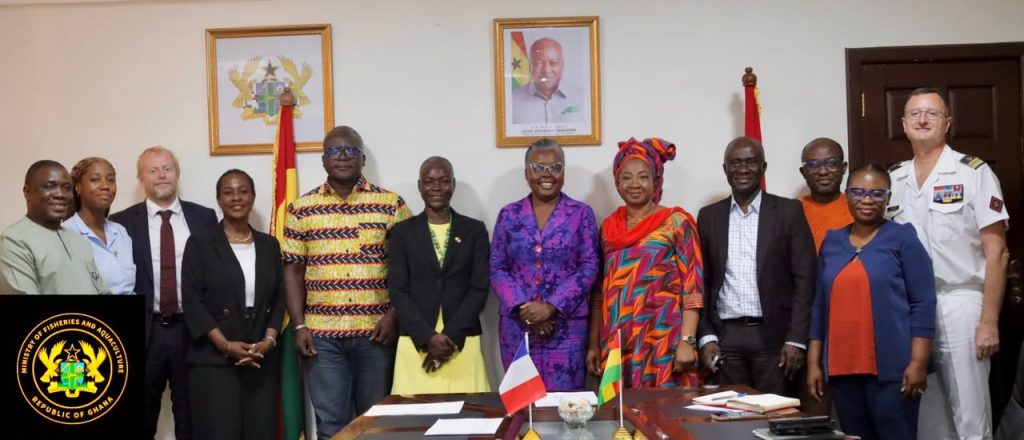
In a landmark step toward strengthening Ghana’s marine governance, Hon. Emelia Arthur has chaired the maiden meeting of the Blue Economy Committee (BEC) in Accra. The high-level engagement marked a critical milestone in the journey toward establishing the Blue Economy Commission, a body that will spearhead the sustainable development of Ghana’s marine and coastal resources.
The meeting brought together key stakeholders and experts who are currently steering the formulation of the Commission. Committee members took the opportunity to brief the Minister on progress made so far, and Hon. Emelia Arthur expressed her satisfaction with the quality of work and the commitment shown by the team.


The Blue Economy Committee includes seasoned professionals with diverse expertise:
1. Dr. Kwame Mfodwo – Consultant, AU-IBAR
2. Prof. Georgina Yaa Oduro – University of Cape Town Coast
3. Dr. Felix Yobo – Director and Sustainable Ocean Focal Point, NDPC
4. Marian Kpakpa – CD, Ministry of Fisheries and Aquaculture
5. Prof. Berchie Asiedu – DED Technical, Fisheries Commission
6. Esi Border Quayson – Director, Marine, Fisheries Commission
7. Fred Kwasi Antwi-Boasi – Coordinator for consultations on the establishment of the Blue Economy Commission
Objectives of the Blue Economy Commission
The proposed Commission aims to promote responsible stewardship of Ghana’s marine assets. Its core focus will include:
Enforcing sustainable fishing practices and promoting eco-friendly technologies
Strengthening Monitoring, Control, and Surveillance (MCS) to combat Illegal, Unreported, and Unregulated (IUU) fishing
Supporting sustainable aquaculture as an alternative to pressure on wild fish stocks
Protecting marine and coastal ecosystems from pollution and degradation
Encouraging investment in fisheries, ecotourism, and marine biotechnology
Developing climate adaptation strategies for the fisheries sector
Implementation Strategy
The Commission’s roadmap will hinge on a multi-faceted implementation strategy, involving: Legislation & Policy Alignment Syncing national laws with international frameworks such as SDG 14 (Life Below Water) and the African Union’s Blue Economy Strategy
Institutional Collaboration, Working closely with the Fisheries Commission, Ghana Maritime Authority, EPA, and research bodies
Public-Private Partnerships (PPP), Mobilizing private sector investment for innovation and sustainability
Community Engagement, Empowering fishers and coastal communities with knowledge on conservation and responsible practices
Monitoring & Evaluation, Deploying data-driven systems to assess fish stock health and the impact of policies
Expected Outcomes
The establishment of the Blue Economy Commission is expected to yield transformative outcomes:
Enhanced fisheries governance and marine resource sustainability
Replenished fish stocks and economic upliftment for fishing communities
Increased contribution of the blue economy to Ghana’s GDP
Improved climate resilience of the fisheries sector
Significant reduction in illegal fishing activities and environmental damage
Government’s Commitment
Hon. Emelia Arthur reaffirmed government’s dedication to a sustainable and prosperous future for Ghana’s coastal and inland waters. She praised the committee’s efforts and called for sustained collaboration moving forward.
“This initiative is a game-changer for Ghana’s fisheries and marine resources. Through strong policies, investments, and community engagement, we can transform our blue economy into a pillar of sustainable growth,” she stated.
As work continues, the Blue Economy Committee is expected to finalize the framework that will establish the Commission, which will play a pivotal role in securing the nation’s marine future balancing environmental conservation with economic prosperity.