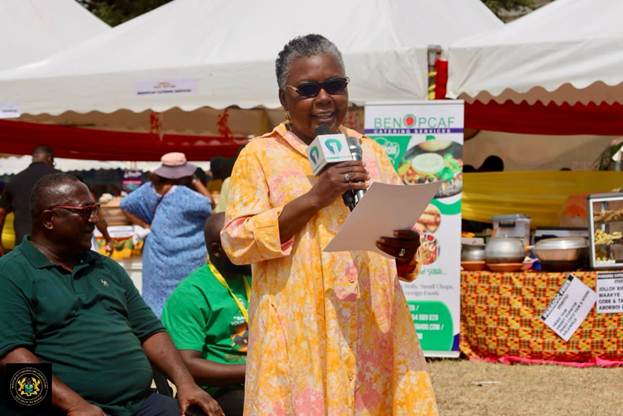
The Minister for Fisheries and Aquaculture, Emelia Arthur, has paid a significant visit to the W.E.B. Du Bois Centre, reaffirming government’s commitment to preserving African history while promoting intellectual and socio-economic development.
The visit, extended as an invitation to the Minister, offered an opportunity to reflect on the enduring legacy of W.E.B. Du Bois, a towering figure in Pan-Africanism who dedicated his life to advocating for the rights, dignity, and freedom of African people across the globe.
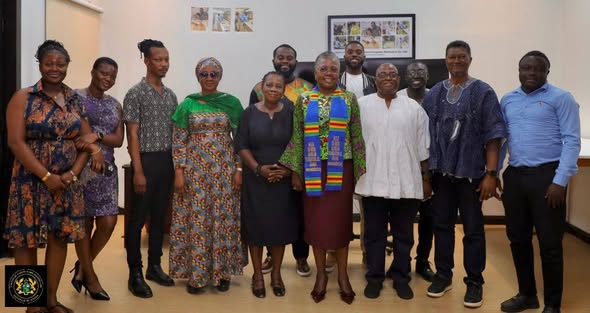
Located in Cantonments, the Centre—once the residence of Du Bois and his wife during their time in Ghana—has been preserved as a museum and research hub, symbolizing his deep connection to the African continent. Du Bois, who worked closely with Kwame Nkrumah, made immense contributions to Ghana’s intellectual and political landscape during the country’s formative years after independence.
During the visit, Hon. Emelia Arthur expressed profound admiration for the work being done by the management and staff of the Centre, describing it as a vital institution for historical preservation and education. She emphasized the need for continued investment and expansion of such heritage sites to deepen public understanding of Africa’s past and inspire future generations.
Reflecting on her personal academic journey, the Minister noted that her early encounters with the works of thinkers like Du Bois shaped her understanding of Africa beyond conventional narratives. According to her, such voices did not merely describe Africa—they challenged the world to understand the continent on its own terms.

“The Centre is not just a place of remembrance,” she remarked. “It is a place of reckoning. It compels us to ask ourselves what we have learned from our history and, more importantly, what we intend to do differently moving forward.”
Hon. Arthur also highlighted growing global recognition of historical injustices, referencing a recent United Nations resolution acknowledging the need for reparatory justice for victims of the trans-Saharan and trans-Atlantic slave trades. She stressed that reparations go beyond financial compensation, describing them as a process of restoring memory, dignity, and the right of African people to define their own identity.
She concluded with a strong call to action, urging African leaders and institutions to design systems that serve the unique needs of their people rather than replicating inherited structures that may no longer be relevant.
“We must invest in our intellect, our industries, and our innovations,” she said. “We must trust in our capacity—not as a slogan, but as a strategy. Across every sector—including fisheries, governance, and education—we must ask ourselves: Are we building an Africa that is dependent, or an Africa that is defining its own future?”
The visit underscores the importance of cultural and historical institutions like the W.E.B. Du Bois Centre in shaping national identity and advancing conversations around Africa’s development in a rapidly evolving global landscape.